

The Digital Transformation Mistake: You Bought Software, Not Systemic Thinking
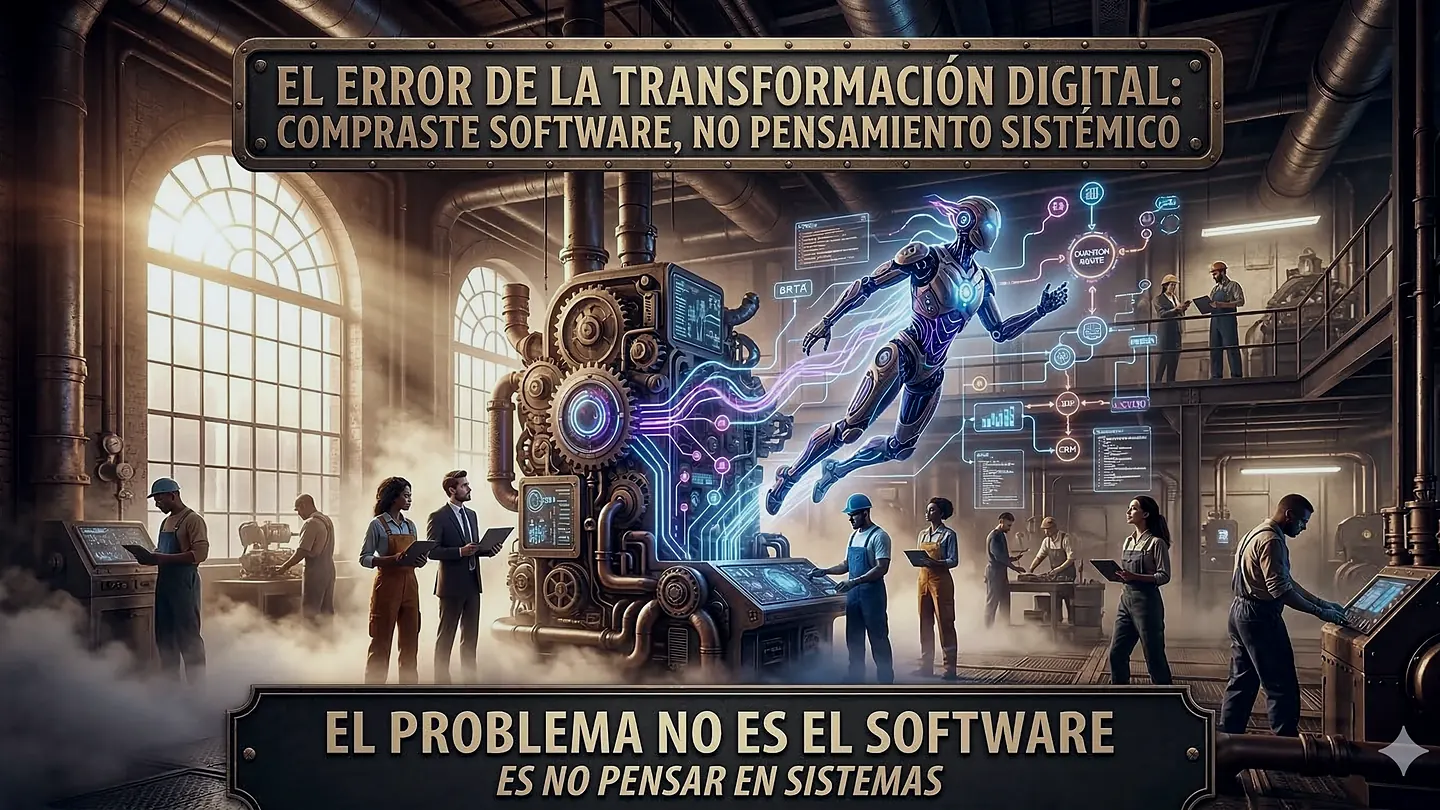
They have been buying digital tools for 10 years and still have the same problems. The new ERP, cloud CRM. Millions invested.
The Digital Transformation Mistake: You Bought Software, Not Systemic Thinking
They've been buying digital tools for 10 years and still have the same problems. The new ERP, cloud CRM, business intelligence. Millions invested. And the operations director is still sending Excel files by email every Monday.
It's not a problem with the tools. It's a problem with how the decision to buy them was made.
I've audited more than twenty digital transformation processes in medium and large companies. The failure pattern is always the same, and it has a name: confusing the tool with the system.
The Software-as-Solution Fallacy
When a company has a coordination problem between departments, it hires a process consultant. The consultant, after three months of analysis, recommends an ERP. The company buys it, implements it in 18 months, spends triple the initial budget, and in the end... the coordination problems are still there, now accompanied by software nobody knows how to use properly.
Why? Because the problem was never the lack of software. The problem was that the processes were broken, the incentives were misaligned, and nobody had questioned why things were done the way they were.
New software inherits old processes. The cloud CRM records the same poorly qualified opportunities that were previously in spreadsheets. The difference is that now there's a nice dashboard showing it in real time.
That's not transformation. It's the digitization of dysfunctions.
What Thinking in Systems Really Means
A system is not a set of connected tools. A system is a set of processes, decisions, information flows and people that behave in a predictable way to produce a result.
When I design AI architectures for companies, the first thing I do is not look at what technology we're going to use. The first thing is to map the existing system: where value is created, where it's lost, what decisions are made with incomplete information, what processes depend on a specific person being available.
Only when you have that map can you identify where technology makes sense. And I guarantee you that in 80% of cases, the first significant improvements don't require AI. They require redesigning how information flows between people.
AI comes later. When the base system works.
Putting an AI agent into a broken process only accelerates chaos. It's like putting a Formula 1 engine in a car with a punctured steering system.
The Three Symptoms of Non-Systemic Thinking
After years working with companies in transformation, I've identified three signals that indicate an organization buys technology without thinking in systems:
First: Technology projects have no process owner. There's someone responsible for the ERP implementation project. But there's nobody responsible for the purchasing process improving as a result. The project ends, the process stays the same, and nobody is accountable because "the software is already implemented".
Second: KPIs measure adoption, not impact. "90% of employees use the new CRM" is an adoption indicator. It doesn't tell you whether more sales are being closed, whether the sales cycle is shorter, whether customers are more satisfied. Companies that think in systems measure the system's output, not tool usage.
Third: Integration is postponed indefinitely. There are five different tools that in theory should communicate with each other. In practice, each lives in its silo and there are people dedicated to copying data from one to another. "The integration" is always on the next quarter's roadmap.
How to Reorient Your Next Technology Investment
The right question before buying any software or contracting any AI project is not "What can this tool do?". The right question is: "What specific process will improve, how will we measure it, and who is responsible for the result?"
If you don't have a concrete and measurable answer to that question, stop the purchase. Not because the tool is bad. But because you're not ready to extract value from it.
The companies that are achieving real results with AI in 2025 are not those with the most advanced technology stack. They are those with the clearest processes, the most organized data and the most aligned incentives. AI is the last step, not the first.
Do you know which process in your company has the most critical information moving in the most manual and slowest way? That's the entry point. Start there, with or without AI.
Digital Transformation in Spanish Companies: Common Mistakes and Systemic Solutions
In Spain, thousands of medium and large companies have invested millions in ERP, CRM and business intelligence platforms without achieving expected results. The problem isn't the technology: it's the absence of systemic thinking prior to purchase. Cinto Casals offers systems architecture audits and digital transformation consulting for Spanish companies.
Comentarios