
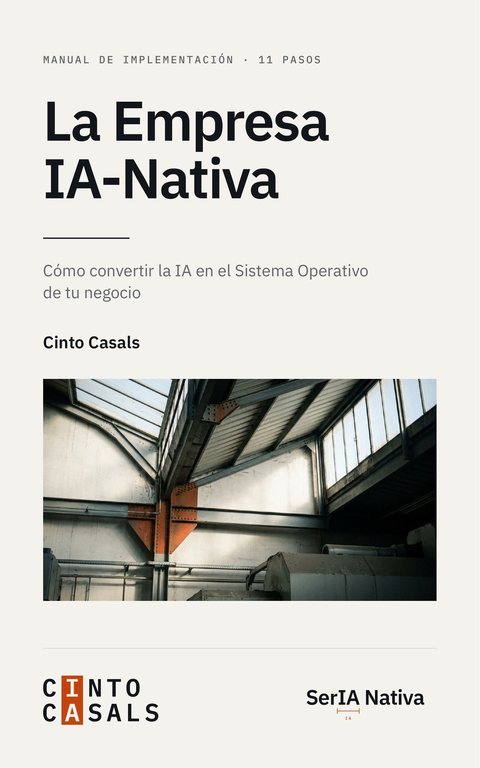

From Steam to Electricity: Why You Need to Redesign Your Knowledge "Factory"

If you use AI just to do the same thing but faster, you are throwing money away.
The Key Historical Analogy
There is a historical analogy that perfectly explains the current moment. When factories moved from steam to electricity, at first they just swapped one big engine for another. Productivity did not improve. It only skyrocketed when they redesigned the entire plant to put small motors on each machine.
Don't automate the task, redesign the process
It's the same with AI. If you only use it to write emails faster, you are swapping the steam engine.
The true value for the AI engineer lies in process reengineering:
- Deconstruct complete workflows.
- Assign autonomous agents to specific tasks.
- Allow human talent to focus on strategy.
❓ Question
Which process in your company is still designed like in the 20th century? It's time to rethink it.
Process Reengineering and History of Technology
- What does the historical analogy of steam vs. electricity teach us about AI implementation?
- It teaches us that replacing old technology with new technology without changing the process generates no value. Factories that just swapped the steam engine for an electric one did not improve productivity. The real revolution came decades later when entire factories were redesigned to leverage the flexibility of individual electric motors. The same applies to AI: automating the old is not enough.
- What is the fundamental difference between automating a task and redesigning a business process?
- Automating a task is doing "the same thing faster" (incremental efficiency), often just accelerating existing bureaucracy. Redesigning a process implies questioning whether current steps are still necessary. With AI, we can eliminate entire steps (like manual validation) and change how value is created, achieving exponential efficiency.
- What role do Autonomous Agents play in the new business architecture?
- Autonomous Agents act as the "individual motors" of the electric analogy. They allow breaking down monolithic processes into small tasks executable independently and in parallel. This frees the human structure from sequential execution and allows the company to scale its work capacity elastically.
- Why can the "do the same thing faster" approach be counterproductive with AI?
- Because current processes are often designed to solve human limitations that AI does not have. If you automate an inefficient process, you only magnify the waste. AI's true potential is unlocked by asking: "If we had infinite processing capacity, how would we design this service from scratch?"
- How does this transformation affect the role of human talent in the company?
- Human talent must stop being the "cog" moving the process to become the "designer" of the process. By delegating operational execution to AI, employees must focus on strategy, quality supervision, and exception management, adding value where the machine cannot reach.
Comentarios